
Preparations to Make to Ensure You Follow Your Habits Consistently
Discover practical and proven preparations to make habit-building effortless. Learn how to design your environment, mindset, and routines to stay consistent and achieve lasting personal growth.
PERSONAL GROWTH
1/1/20262 min read
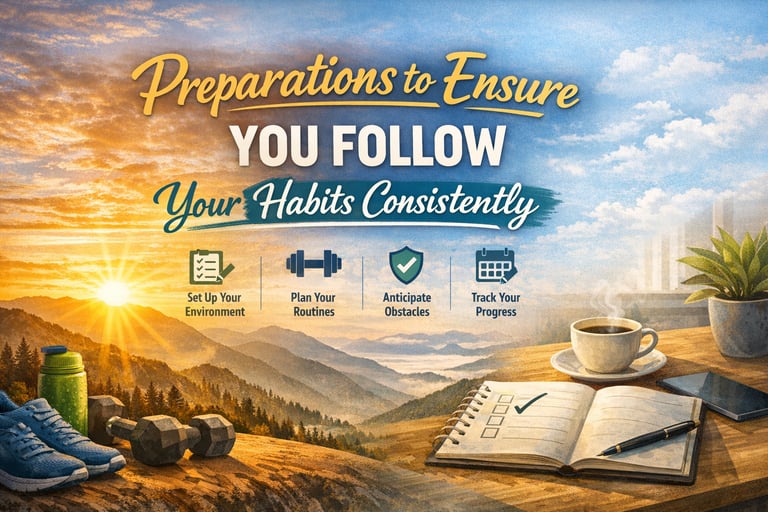

Building good habits is not about willpower alone. The real secret lies in preparation. When your environment, mindset, and daily structure support your habits, consistency becomes natural rather than forced.
In this article, you will learn strategic preparations that make it significantly easier to follow your habits—whether they relate to health, productivity, self-care, spiritual growth, or wealth creation.
Why Preparation Matters More Than Motivation
Motivation is temporary. Preparation is permanent.
Most people fail at habits because they rely on enthusiasm instead of systems. When life becomes busy, stressful, or emotionally demanding, motivation fades—but well-prepared habits continue.
Preparation:
Reduces decision fatigue
Eliminates friction
Creates automatic behavior
Protects habits during low-energy days
1. Get Clear on Why the Habit Matters
Before preparing externally, prepare internally.
Ask yourself:
Why is this habit important to me?
What pain will continue if I don’t follow it?
What identity does this habit support?
Example:
Instead of “I want to exercise,” shift to:
“I am someone who respects and protects my body.”
When habits align with identity, consistency improves dramatically.
2. Design Your Environment for Success
Your environment silently controls your behavior.
Prepare Your Physical Space
Keep workout clothes visible
Place healthy snacks at eye level
Keep books, journals, or meditation cushions easily accessible
Remove distractions related to bad habits
Rule: Make good habits obvious and bad habits invisible.
3. Prepare Your Tools in Advance
Never rely on last-minute effort.
Examples:
Chop vegetables the night before
Pre-schedule workouts or walks
Keep affirmations printed or saved on your phone
Prepare weekly meal plans
Set reminders and alarms
When tools are ready, action becomes effortless.
4. Reduce the Habit to Its Simplest Form
One major reason habits fail is over-ambition.
Use the “Minimum Viable Habit” Rule:
5 minutes of movement
1 page of reading
3 deep breaths
Writing 1 sentence in a journal
Consistency matters more than intensity. You can always expand later.
5. Attach New Habits to Existing Routines
This is known as habit stacking.
Examples:
After brushing teeth → gratitude affirmations
After morning tea → 5 minutes of stretching
After lunch → short walk
Before sleep → digital detox
Your brain loves patterns. Use existing routines as anchors.
6. Prepare for Obstacles in Advance
Most habits break when life becomes inconvenient.
Prepare answers to:
What will I do on busy days?
What if I feel tired or emotional?
What if I miss one day?
Key Rule: Never miss twice.
One missed day is human. Two missed days become a pattern.
7. Track Your Habits Visually
What gets measured gets managed.
Preparation ideas:
Habit tracker printable
Wall calendar with check marks
Digital habit tracking apps
Bullet journal habit logs
Seeing progress reinforces consistency and builds momentum.
8. Prepare Your Mind for Imperfection
Perfectionism kills habits.
Prepare mentally to:
Accept slow progress
Expect emotional resistance
Allow flexibility
Forgive yourself quickly
Habits grow through compassion, not punishment.
9. Align Habits With Your Energy Cycles
Not all habits belong in the morning.
Prepare by identifying:
High-energy hours → challenging habits
Low-energy hours → gentle habits
For example:
Morning: exercise, deep work
Afternoon: light movement, routine tasks
Evening: reflection, gratitude, self-care
Working with your energy makes habits sustainable.
10. Create Accountability Systems
Preparation improves when habits are shared or tracked externally.
Options:
Share goals with a trusted friend
Join a challenge or group
Use public commitments
Reward yourself for consistency
Accountability converts intention into action.
11. Reinforce Habits With Positive Emotion
The brain repeats what feels rewarding.
Prepare small rewards:
A calming tea after journaling
A relaxing playlist after workouts
A gratitude ritual after completing tasks
Emotion strengthens memory—and habits live in memory.
Preparation Is Self-Respect
Following habits consistently is not about discipline—it is about self-support.
When you prepare:
You reduce struggle
You honor your future self
You create a lifestyle that works with you, not against you
Start with one habit. Prepare it fully. Then watch consistency become your new normal.
The Prime Chronicle © 2024
Stay Inspired
Get fresh wellness tips straight to your inbox
We care about your data in our privacy policy.