
How Gratitude Rewires Your Brain for Happiness
Discover how gratitude rewires your brain for happiness by boosting dopamine, reducing stress, and strengthening positive neural pathways. Learn the science and daily practices.
PERSONAL GROWTH
12/29/20253 min read

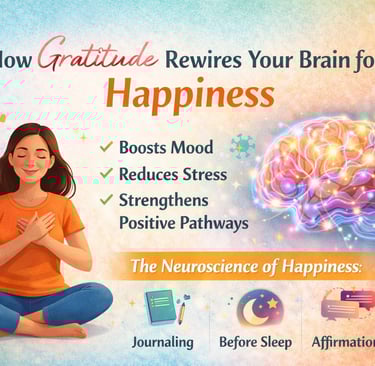
Gratitude is more than a positive emotion—it is a powerful mental habit that can literally rewire your brain for happiness. Modern neuroscience confirms what ancient wisdom has long suggested: practicing gratitude consistently changes brain chemistry, reduces stress, and improves emotional well-being.
In a world driven by stress, comparison, and constant stimulation, gratitude acts as a natural reset button for the mind.
This article explains how gratitude affects the brain, the science behind it, and how you can use gratitude daily to cultivate lasting happiness.
What Is Gratitude from a Neuroscience Perspective?
Gratitude is the conscious recognition and appreciation of positive aspects of life—both big and small. From a neurological standpoint, gratitude activates specific neural pathways associated with reward, emotional regulation, and resilience.
When practiced regularly, gratitude shifts the brain away from survival-based thinking and toward abundance-based perception.
The Brain Regions Activated by Gratitude
Scientific studies using brain imaging show that gratitude stimulates key areas of the brain:
Prefrontal cortex – improves decision-making and emotional control
Hypothalamus – regulates stress, sleep, and hormones
Ventral tegmental area (VTA) – associated with pleasure and motivation
Repeated activation strengthens these neural circuits, making positive thinking more automatic over time.
How Gratitude Rewires the Brain for Happiness
1. Gratitude Increases Dopamine and Serotonin
Gratitude naturally boosts dopamine (the motivation chemical) and serotonin (the happiness and mood-stabilizing neurotransmitter).
These chemicals:
Improve mood
Reduce anxiety
Enhance motivation
Increase feelings of contentment
Unlike external stimulants, gratitude trains the brain to produce these chemicals internally.
2. Gratitude Reduces Stress and Cortisol Levels
Chronic stress keeps the brain in a constant fight-or-flight state. Gratitude interrupts this cycle by activating the parasympathetic nervous system.
Regular gratitude practice:
Lowers cortisol (stress hormone)
Calms the nervous system
Improves emotional regulation
Over time, the brain becomes less reactive to triggers and negative experiences.
3. Gratitude Strengthens Positive Neural Pathways
The brain operates on a principle known as neuroplasticity—neurons that fire together wire together.
When you focus on gratitude daily:
Positive neural pathways strengthen
Negative thought loops weaken
The brain becomes biased toward optimism
This explains why grateful people naturally experience more joy and resilience, even during challenges.
4. Gratitude Shifts the Brain from Lack to Abundance
The human brain has a natural negativity bias designed for survival. Gratitude counteracts this bias by training the mind to look for what is working rather than what is missing.
This shift:
Reduces comparison and envy
Improves self-esteem
Creates emotional safety
Happiness becomes a baseline state rather than a temporary emotion.
5. Gratitude Improves Emotional Resilience
People who practice gratitude regularly recover faster from emotional setbacks. Gratitude helps the brain contextualize challenges rather than catastrophize them.
Benefits include:
Reduced symptoms of depression
Better coping during stress
Improved emotional stability
Gratitude does not deny pain—it changes how the brain processes it.
Scientific Benefits of Gratitude on Mental Health
Research consistently shows that gratitude:
Improves sleep quality
Reduces anxiety and depressive symptoms
Enhances overall life satisfaction
Strengthens relationships
Improves physical health markers
These benefits compound over time when gratitude becomes a daily habit.
Simple Daily Gratitude Practices That Rewire the Brain
1. Gratitude Journaling
Write down 3 things you are grateful for each day. Focus on emotions, not just events.
2. Gratitude Before Sleep
Reflect on one positive moment from the day before going to bed to reinforce positive memory consolidation.
3. Gratitude During Stress
Ask yourself: What can I learn from this situation? or What remains stable right now?
4. Gratitude Affirmations
Use statements such as:
“I appreciate the good unfolding in my life.”
“I am grateful for my progress, even when it feels slow.”
How Long Does It Take Gratitude to Rewire the Brain?
Most studies suggest noticeable changes within 21 to 30 days of consistent practice. Structural brain changes may occur over several months, depending on frequency and emotional engagement.
Consistency matters more than intensity.
Common Myths About Gratitude
Gratitude does not ignore problems — it reframes perception
You don’t need to feel grateful all the time — practice is enough
Gratitude is not forced positivity — it is awareness
Gratitude is one of the most accessible and scientifically supported tools for improving happiness. By practicing gratitude daily, you are not just changing your thoughts—you are rewiring your brain to experience more peace, joy, and emotional resilience.
Happiness, in this sense, is not something you chase. It is something you train.
The Prime Chronicle © 2024
Stay Inspired
Get fresh wellness tips straight to your inbox
We care about your data in our privacy policy.